Xata is joining ClickHouse
By:
Monica SarbuPublished:
Reading time:
6 min readToday, we're excited to announce that Xata is joining ClickHouse to bring agentic capabilities to ClickHouse Managed Postgres.
Together with ClickHouse, we're building a Postgres platform designed for modern applications and AI agents, combining high-performance production workloads on local NVMe storage with Xata’s technology for instant database provisioning, instant copy-on-write branching, and scale-to-zero compute.
Nothing changes for Xata customers in the short term and we continue to accept new sign-ups. In parallel, we're working on bringing branching and an agentic tier to ClickHouse Managed Postgres. We will eventually migrate Xata customers to ClickHouse Managed Postgres. You can also read ClickHouse's announcement.
What is Xata
It’s undeniable that this year software development has changed forever, with agents and software factories now doing the grunt work. However, the increase in coding output has uncovered new bottlenecks. For many companies the database workflows are now the bottleneck: every pull request and every agent run needs a safe, isolated database with production-like data.
Traditionally, creating a copy of a production database is a slow and expensive process, especially when dealing with terabytes of data. Creating a database for every pull request or agent run simply doesn't scale with traditional cloning. With copy-on-write branching, however, there's no need to copy the data, making it possible to create a new branch with production data in seconds.
This is exactly what we’ve built at Xata. Even if a database has multiple terabytes of data, creating a branch takes only around 3 seconds. This means the schema and the data appear as if they were instantly copied to the child branch. At the same time, the child branch is fully independent: it has its own compute, running on a different physical node, and nothing that happens on the child branch impacts the parent database.
The key capabilities are:
- Instant database provisioning: Create a new, fully functional Postgres database instantly.
- Instant copy-on-write branching: Create database branches in seconds, without duplicating the underlying data. You only pay for the diff: create 50 branches of a 1TB database and you’re billed for something much closer to 1TB than 50TB.
- Scale-to-zero compute: Automatically suspend idle databases and wake them on the next connection, in about one second, minimizing costs.
- Anonymized production data: Remove sensitive information before data leaves production, so developers and agents can safely work with database branches.
Together, these capabilities make it remarkably cheap to run a branch per PR, per agent run, or even per SQL session. AI-native customers like Sapien, Enginy, David AI, Runner AI, and LoopAI each create thousands of database branches every week.
You might also know Xata from our open-source projects in the Postgres ecosystem, including pgstream, for logical replication with anonymization and DDL support, and pgroll, for zero-downtime, reversible schema changes.
Why ClickHouse
Earlier this year, ClickHouse launched ClickHouse Managed Postgres, which became generally available today. Built on local NVMe storage, it's currently the fastest Postgres service out there, and not by a small margin.
When we started talking with the ClickHouse Managed Postgres team, it quickly became clear just how complementary the two services are: ClickHouse Managed Postgres is optimized for high-throughput, long-lived production workloads, while Xata is designed to provision large numbers of small, short-lived databases in seconds, with production-like data and capabilities like instant branching and scale-to-zero that are particularly well suited for agentic workloads.
Both platforms run unmodified vanilla Postgres and share a strong focus on reliability and stability. The common foundation puts us in a great position to move quickly on integrating the two platforms. In fact, David AI is an example of a customer that already uses ClickHouse Managed Postgres and Xata together and they shared the following with us:
As an AI company working with large volumes of data, we need reliable infrastructure that help us move fast. We moved from Neon to ClickHouse Managed Postgres for better reliability and performance, and our users immediately noticed how much faster everything felt. Xata’s branching has been a great fit for our devs (and AI coding agents!), making it easy to build and test in parallel. Bringing both together means high-performance Postgres and instant branching in a single platform, simplifying our infrastructure and giving our team more time to build.
Best-in-class OLTP and OLAP
By almost any measure, Postgres is the most popular OLTP database and ClickHouse is the most popular OLAP database. Combining the two is something teams have been stitching together themselves for years. The Postgres team at ClickHouse has been making that integration first-class: very fast replication from Postgres into ClickHouse and a unified query layer to build applications.
An integrated transactional and analytical data platform is something we've wanted to build since Xata's early days, when our first product paired Postgres with a search and analytics engine.
On a personal level, we've long admired ClickHouse and already knew the founders and many of the engineers, which gives us confidence that together we can take this vision much further.
What Xata enables
A database branch for every pull request and agent run
The GitHub integration enables automatically creating an isolated database branch for every pull request. These branches can be integrated into CI/CD pipelines, allowing code changes to be safely tested before merging into production. Since they are only needed for testing, branches are often scaling to zero after only a few minutes, minimizing costs.
The same approach applies to coding agents, where every agent run can have its own isolated database to develop and test changes without affecting production.
For details on the branch-per-PR use case and the cost savings it provides, see this blog post.
Powering AI platforms
AI platforms that embed Postgres are seeing an explosion in demand: first thousands, then hundreds of thousands, and eventually millions of databases per week. There are two main use cases: instant database provisioning for every new application, and a database branch for every deployment preview, allowing code changes to be tested safely against production data.
Because unused databases scale to zero, platforms can run very large fleets of small, mostly idle databases at a fraction of the cost, while keeping full compatibility, since it's simply vanilla Postgres.
How it works
Two key technologies enable fast branching and short wake-up times: our Xatastor storage engine and warm pools for compute instances.
Xatastor is our storage engine, which provides separation of storage and compute, high multi-tenancy, copy-on-write branching, compression, thin provisioning, and more. It exposes ZFS zvols over the network using the NVMe/TCP protocol. Because it works at the block-device level, we can run unmodified vanilla PostgreSQL. For a deep-dive into the Xatastor architecture, see this dedicated blog post.
We use warm pools of compute instances to obtain super fast provisioning, wake-up after scale-to-zero, and branching times. This removes the actual node and pod provisioning from the hot path of making a new database or branch available. You can find more information about how this works in this blog post.
What's next
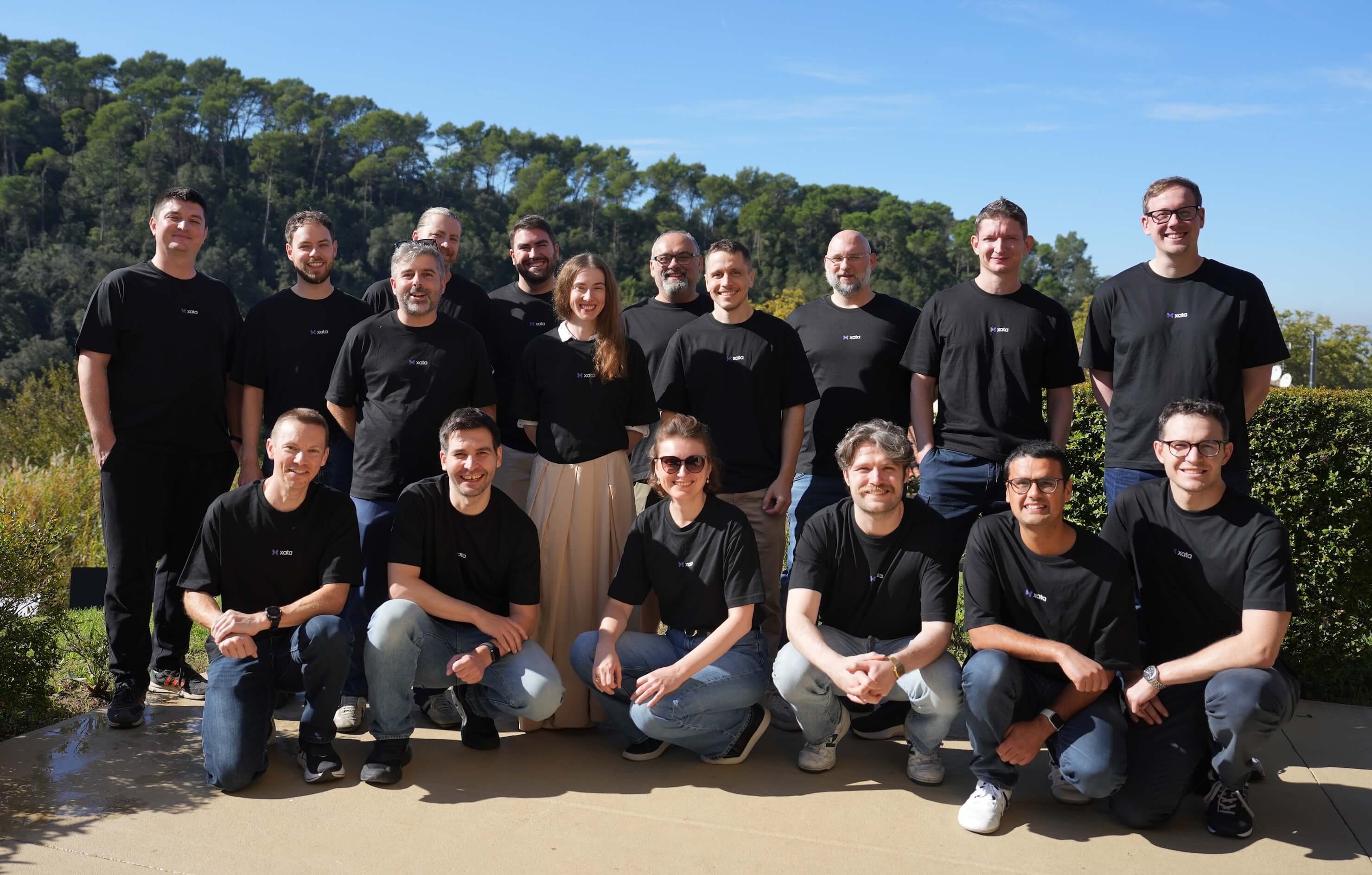
Building Xata has been an incredible journey over the last five years. We're extremely proud of the technology we've built, and even more proud of the team behind it, which is now joining ClickHouse.
We've tackled some really difficult engineering challenges, and it's been incredibly rewarding to see developers and customers embrace these capabilities, creating exponentially more branches as they expand their usage.
What excites us most about this next chapter is that the vision behind Xata is more relevant than ever, and as part of ClickHouse, we're in the best possible position to bring it to fruition.
What this means for you:
- If you're a Xata customer: you can continue using it as usual. We'll integrate Xata's features into ClickHouse Managed Postgres, and once there's feature parity, we'll migrate customers as smoothly as possible, ideally with no impact on the service.
- If you're a ClickHouse Managed Postgres customer: branching, scale-to-zero and an agentic tier are coming to ClickHouse Managed Postgres
- If you're new to both: you can get started with ClickHouse Managed Postgres or sign up for Xata today.
We're excited about what we can build together with ClickHouse, and this is just the beginning.
Give every agentic workload its own Postgres branch
Create instant database clones with production-like data for every agent, workflow, and CI/CD pipeline.
Related Posts
A thousand Postgres branches for $1
See how we reduced branching times from 20+ seconds to around a second and what use-cases these speed improvements enable.
Inside Xatastor: ZFS + NVMe-oF for millions of Postgres databases
Read the technical details of our new distributed storage system, which is the key to scaling to a huge number of Postgres instances.