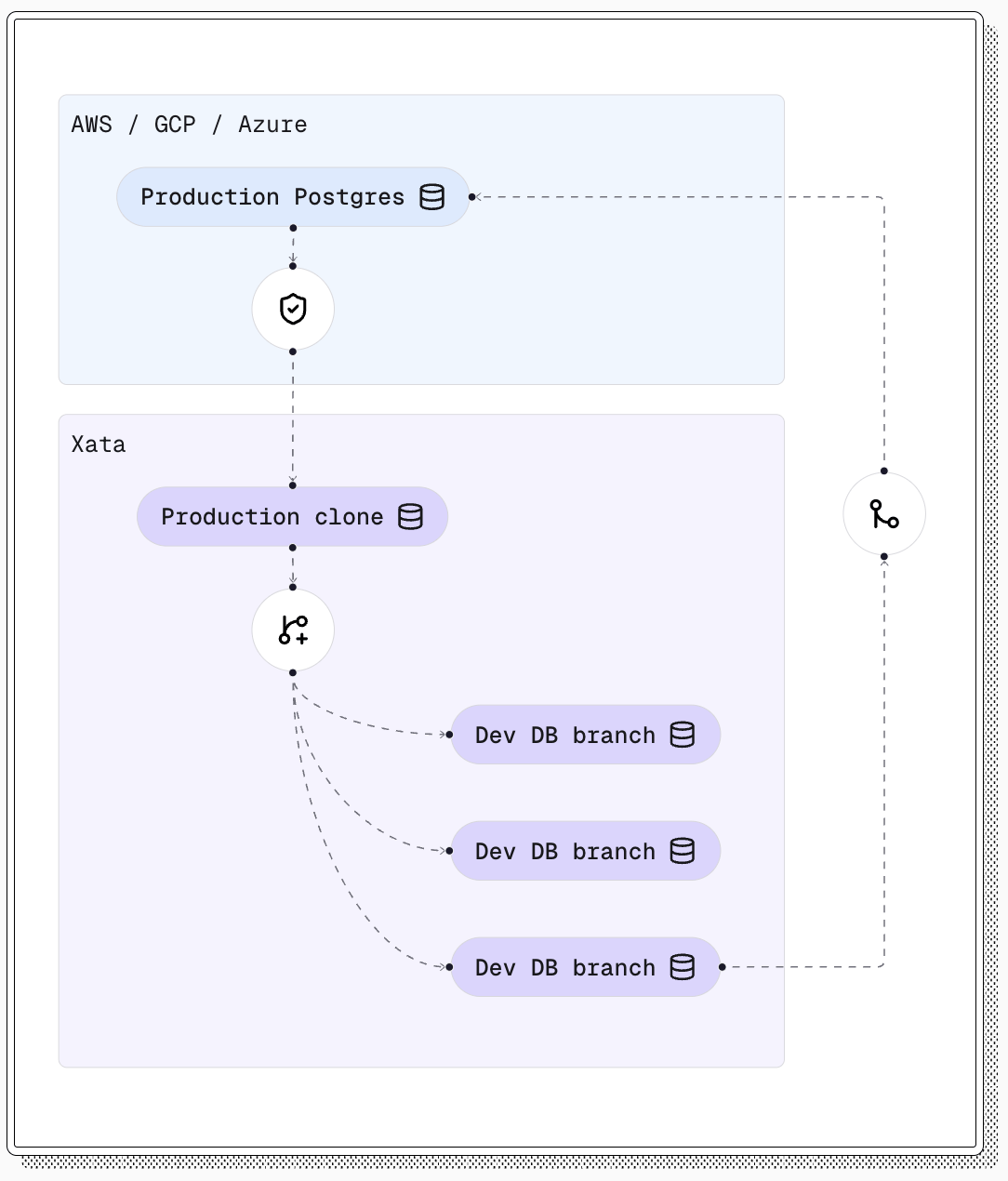
pgstream is a command-line tool for streaming PostgreSQL data changes to various targets. This document covers all available commands and their usage.

Installation

curl -L https://github.com/xataio/pgstream/releases/latest/download/pgstream.linux.amd64 -o pgstream
chmod +x pgstream
sudo mv pgstream /usr/local/bin/

go install github.com/xataio/pgstream@latest

git clone https://github.com/xataio/pgstream.git
cd pgstream
go build -o pgstream ./cmd

brew tap xataio/pgstream
brew install pgstream

Global Flags

These flags are available for all commands:
Description: .env or .yaml config file to use with pgstream if any
Default: -
Description: Log level for the application. One of trace, debug, info, warn, error, fatal, panic
Default: debug
Description: Show help information
Default: -

Commands

init

Initialises pgstream, creating the replication slot and the relevant tables/functions/triggers under the configured internal pgstream schema. It performs the same operations as the --init flag on the run command.
pgstream init [flags]
Description: The init command prepares your PostgreSQL database for streaming by:
  • Creating a logical replication slot with the specified name
  • Creating the internal pgstream schema for tracking changes
  • Setting up necessary functions and triggers for change data capture
  • Configuring the database objects required for logical replication
Prerequisites:
  • PostgreSQL must have wal_level = logical
  • User must have replication privileges (REPLICATION role)
  • max_replication_slots must allow for additional slots
  • User must have privileges to create schemas, functions, and triggers
Flags:
  • --postgres-url - Source postgres URL where pgstream setup will be run
  • --replication-slot - Name of the postgres replication slot to be created by pgstream on the source url
Examples:
pgstream init -c config.yaml
pgstream init -c config.env

run

Run starts a continuous data stream from the configured source to the configured target.
pgstream run [flags]
Description: The run command is the main operation mode for pgstream. It:
  • Establishes a connection to the source database
  • Connects to the existing replication slot (created by init)
  • Continuously reads WAL events from the replication stream
  • Processes and transforms data according to configuration
  • Streams changes to configured targets (Kafka, PostgreSQL, Elasticsearch, OpenSearch)
  • Runs continuously until interrupted (Ctrl+C) or receives a termination signal
  • Gracefully shuts down on SIGTERM/SIGINT
  • Resumes from the last confirmed WAL position
Prerequisites:
  • Database must be initialized with pgstream init
  • Replication slot must exist and be available
  • Target systems must be accessible and properly configured
  • Source database must have logical replication enabled
Flags:
  • --source - Source type. One of postgres, kafka
  • --source-url - Source URL
  • --target - Target type. One of postgres, opensearch, elasticsearch, kafka
  • --target-url - Target URL
  • --replication-slot - Name of the postgres replication slot for pgstream to connect to
  • --snapshot-tables - List of tables to snapshot if initial snapshot is required, in the format <schema>.<table>. If not specified, the schema public will be assumed. Wildcards are supported
  • --reset - Whether to reset the target before snapshotting (only for postgres target)
  • --profile - Whether to expose a /debug/pprof endpoint on localhost:6060
  • --init - Whether to initialize pgstream before starting replication
  • --dump-file - File where the pg_dump output will be written if initial snapshot is enabled when using pgdump/restore
Examples:
pgstream run --source kafka --source-url <kafka-url> --target elasticsearch --target-url <elasticsearch-url>
pgstream run --config config.yaml --log-level info
pgstream run --config config.env
Output Files (when --profile is enabled):
  • cpu.prof - CPU profiling data for performance analysis
  • mem.prof - Memory allocation profiling data

snapshot

Snapshot performs a snapshot of the configured source Postgres database into the configured target.
pgstream snapshot [flags]
Description: The snapshot command creates a point-in-time copy of database tables. It:
  • Connects to the source PostgreSQL database
  • Reads all existing data from specified tables/schemas
  • Transforms and streams the data to configured targets
  • Exits after completing the snapshot operation
Prerequisites:
  • Source PostgreSQL database must be accessible
  • Target system must be accessible and properly configured
  • User must have SELECT privileges on tables to be snapshotted
  • For PostgreSQL targets: user must have write privileges
Flags:
  • --postgres-url - Source postgres database to perform the snapshot from
  • --target - Target type. One of postgres, opensearch, elasticsearch, kafka
  • --target-url - Target URL
  • --tables - List of tables to snapshot, in the format <schema>.<table>. If not specified, the schema public will be assumed. Wildcards are supported
  • --reset - Whether to reset the target before snapshotting (only for postgres target)
  • --profile - Whether to produce CPU and memory profile files, as well as exposing a /debug/pprof endpoint on localhost:6060
  • --dump-file - File where the pg_dump output will be written
Examples:
pgstream snapshot --config config.yaml --log-level info
pgstream snapshot --config config.env
Use Cases:
  • Bulk data export for analytics
  • Creating test datasets
  • Backfilling data after system setup
Output Files (when --profile is enabled):
  • cpu.prof - CPU profiling data for performance analysis
  • mem.prof - Memory allocation profiling data

status

Checks the status of pgstream initialisation and provided configuration.
pgstream status [flags]
Description: The status command provides information about:
  • Replication slot status
  • Internal pgstream schema and objects status
  • Overall streaming infrastructure health
  • Configuration validation results
Prerequisites:
  • Access to the source PostgreSQL database
  • Replication slot should exist
Flags:
  • --postgres-url - Source postgres URL where pgstream has been initialised
  • --replication-slot - Name of the postgres replication slot created by pgstream on the source url
  • --json - Output the status in JSON format
Examples:
pgstream status -c pg2pg.env
pgstream status -c pg2pg.yaml --json
Sample Output:
✅ SUCCESS  pgstream status check encountered no issues
Initialisation status:
 - Pgstream schema exists: true
 - Pgstream schema_log table exists: true
 - Migration current version: 8
 - Migration status: success
 - Replication slot name: pgstream_postgres_slot
 - Replication slot plugin: wal2json
 - Replication slot database: postgres
Config status:
 - Valid: true
Transformation rules status:
 - Valid: true
Source status:
 - Reachable: true

destroy

It destroys any pgstream setup, removing the replication slot and all the relevant tables/functions/triggers, along with the internal pgstream schema.
pgstream destroy [flags]
Description: The destroy command cleans up all resources created by pgstream init:
  • Drops the replication slot
  • Removes the internal pgstream schema and all its objects
  • Removes all pgstream-related functions and triggers
  • ⚠️ Warning: This is destructive and will lose replication position
Prerequisites:
  • Access to the source PostgreSQL database
  • User must have privileges to drop schemas, functions, and replication slots
  • pgstream should be initialized (objects should exist to be destroyed)
Flags:
  • --postgres-url - Source postgres URL where pgstream destroy will be run
  • --replication-slot - Name of the postgres replication slot to be deleted by pgstream from the source url
Examples:
pgstream destroy -c config.yaml
pgstream destroy -c config.env
⚠️ Important Notes:
  • This will stop any running pgstream instances using these resources
  • You will lose the current replication position
  • All pgstream tracking data will be permanently removed
  • You can recreate resources later with pgstream init

version

Displays version information for pgstream.
pgstream version
Description: Shows the current version of the pgstream binary. Example:
$ pgstream version
pgstream version v0.8.1

Configuration

pgstream uses YAML or .env configuration files. The configuration can be specified via:
  1. Command-line flag: --config /path/to/config.yaml or -c /path/to/config.env
  2. Environment variable: PGSTREAM_CONFIG=/path/to/config.yaml
For more information about the configuration options, check out the configuration documentation.

Examples

Complete Setup Workflow

pgstream run --source postgres --source-url "postgres://user:pass@localhost:5432/source_db" --target postgres --target-url "postgres://user:pass@localhost:5432/target_db" --replication-slot "pgstream_slot" --snapshot-tables "public.*" --init

Configuration File Workflow

cat > config.yaml <<EOF
source:
  postgres:
    url: "postgres://user:pass@localhost:5432/source_db"
    replication:
      replication_slot: "pgstream_slot"

target:
  postgres:
    url: "postgres://user:pass@localhost:5432/target_db"
EOF

pgstream init -c config.yaml

pgstream status -c config.yaml

pgstream run -c config.yaml

Development with Profiling

pgstream snapshot -c config.yaml --profile

pgstream run -c config.yaml --profile

go tool pprof http://localhost:6060/debug/pprof/profile
go tool pprof http://localhost:6060/debug/pprof/heap

Multi-target Streaming

pgstream run --source postgres --source-url "postgres://user:pass@localhost:5432/source_db" --target kafka --target-url "localhost:9092" --replication-slot "pgstream_slot"

pgstream run --source kafka --source-url "localhost:9092" --target elasticsearch --target-url "http://localhost:9200" --replication-slot "pgstream_slot"

pgstream run --source kafka --source-url "localhost:9092" --target opensearch --target-url "http://localhost:9200" --replication-slot "pgstream_slot"

Environment Variable Configuration

export PGSTREAM_POSTGRES_LISTENER_URL="postgres://user:pass@localhost:5432/source_db"
export PGSTREAM_POSTGRES_REPLICATION_SLOT_NAME="pgstream_slot"
export PGSTREAM_LOG_LEVEL="info"

pgstream init
pgstream status
pgstream run --source postgres --target kafka --target-url "localhost:9092"

Troubleshooting

Common Issues

1. Initialization Failures
psql "postgres://user:password@host:port/database" -c "SHOW wal_level;"
psql "postgres://user:password@host:port/database" -c "SHOW max_replication_slots;"

psql "postgres://user:password@host:port/database" -c "SELECT rolreplication FROM pg_roles WHERE rolname = 'your_user';"
2. Replication Slot Conflicts
pgstream status --postgres-url "postgres://user:pass@host:port/db" --replication-slot "slot_name"

pgstream destroy --postgres-url "postgres://user:pass@host:port/db" --replication-slot "slot_name"
3. Status Check Issues
pgstream status -c config.yaml --json

pgstream status --postgres-url "postgres://user:pass@host:port/db" --replication-slot "slot_name"

Command-specific Troubleshooting

Init Command:
pgstream init --postgres-url "postgres://user:pass@host:port/db" --replication-slot "slot_name" --log-level debug
Run Command:
pgstream run -c config.yaml --init

pgstream run -c config.yaml --snapshot-tables "public.users,public.orders"
Snapshot Command:
pgstream snapshot -c config.yaml --reset

pgstream snapshot -c config.yaml --profile --dump-file custom_dump.sql

Best Practices

  • Use run with the --init flag to ensure pgstream can properly replicate schema changes
  • snapshot only requires read access on your Postgres source, so it’s a good alternative for non invasive syncs
  • If you need a snapshot and replication, use run with initial snapshot to prevent data loss
  • Use the status command to validate your transformer configuration and your pgstream replication setup
  • Use destroy carefully, since it will remove everything used by pgstream, including the replication slot

Getting Help

For immediate help with any command:
pgstream --help
pgstream init --help
pgstream run --help
pgstream snapshot --help
pgstream status --help
pgstream destroy --help