

Documentation Index
Fetch the complete documentation index at: https://xata.io/docs/llms.txt
Use this file to discover all available pages before exploring further.
pgstream is constructed as a streaming pipeline, where data from one module streams into the next, eventually reaching the configured targets. It keeps track of schema changes and replicates them along with the data changes to ensure a consistent view of the source data downstream. This modular approach makes adding and integrating target implementations simple and painless.
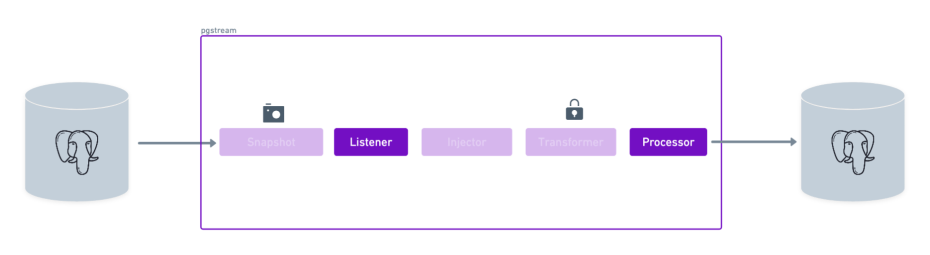
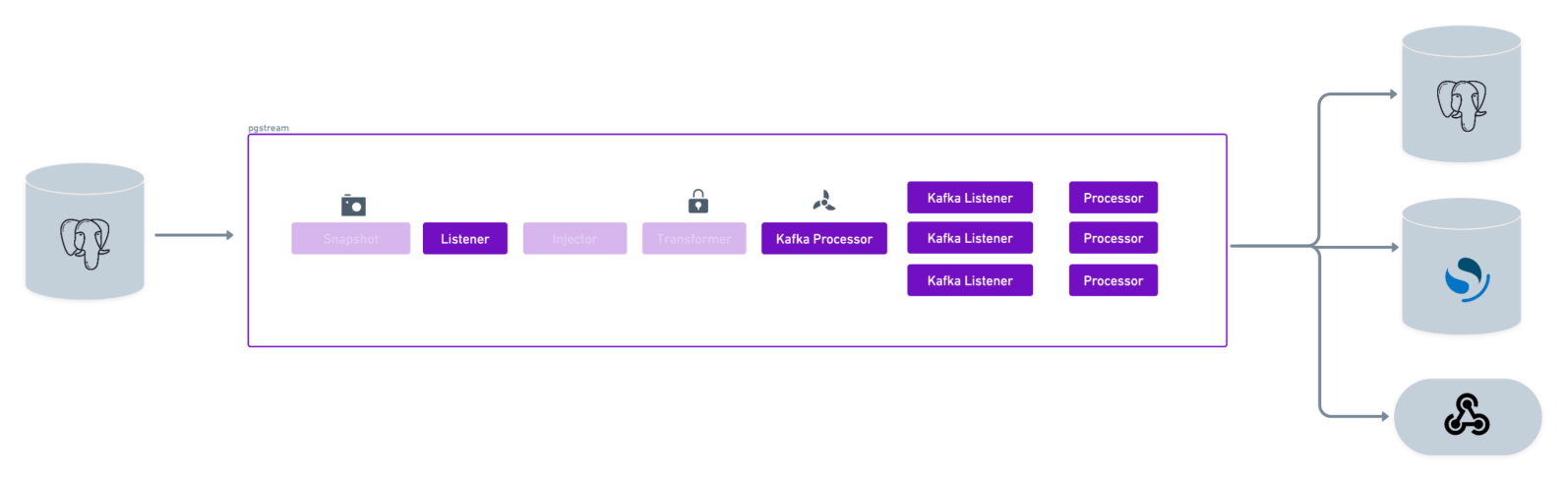 At a high level the implementation is split into WAL listeners and WAL processors.
WAL Listener
A listener is anything that listens for WAL data, regardless of the source. It has a single responsibility: consume and manage the WAL events, delegating the processing of those entries to modules that form the processing pipeline. Depending on the listener implementation, it might be required to have a checkpointer to flag the events as processed once the processor is done. The current implementations of the listener include:- Postgres listener: listens to WAL events directly from the replication slot. Since the WAL replication slot is sequential, the Postgres WAL listener is limited to run as a single process. The associated Postgres checkpointer will sync the LSN so that the replication lag doesn’t grow indefinitely. It can be configured to perform an initial snapshot when pgstream is first connected to the source PostgreSQL database (see details in the snapshots documentation).
- Postgres Snapshoter: produces events by performing a snapshot of the configured PostgreSQL database, as described in the snapshots documentation. It doesn’t start continuous replication, so once all the snapshotted data has been processed, the pgstream process will stop.
- Kafka reader: reads WAL events from a Kafka topic. It can be configured to run concurrently by using partitions and Kafka consumer groups, applying a fan-out strategy to the WAL events. The data will be partitioned by database schema by default. The associated Kafka checkpointer will commit the message offsets per topic/partition so that the consumer group doesn’t process the same message twice, and there’s no lag accumulated.
WAL Processor
A processor processes a WAL event. Depending on the implementation it might also be required to checkpoint the event once it’s done processing it as described above. Wherever possible the processors are implemented to continuously consume the replication slot by using configurable memory guards, aiming to prevent the replication slot lag from growing out of control. The current implementations of the processor include:- Kafka batch writer: it writes the WAL events into a Kafka topic, using the event schema as the Kafka key for partitioning. This implementation allows to fan-out the sequential WAL events, while acting as an intermediate buffer to avoid the replication slot to grow when there are slow consumers. It has a memory guarded buffering system internally to limit the memory usage of the buffer. The buffer is sent to Kafka based on the configured linger time and maximum size. It treats both data and schema events equally, since it doesn’t care about the content.
- Search batch indexer: it indexes the WAL events into an OpenSearch/Elasticsearch compatible search store. It implements the same kind of mechanism than the Kafka batch writer to ensure continuous processing from the listener, and it also uses a batching mechanism to minimise search store calls. The WAL event identity is used as the search store document id, and the LSN is used as the document version. Events that do not have an identity are not indexed.
- Webhook notifier: it sends a notification to any webhooks that have subscribed to the relevant wal event. It relies on a subscription HTTP server receiving the subscription requests and storing them in the shared subscription store which is accessed whenever a wal event is processed. It sends the notifications to the different subscribed webhook urls in parallel based on a configurable number of workers (client timeouts apply). Similar to the two previous processor implementations, it uses a memory guarded buffering system internally, which allows to separate the wal event processing from the webhook url sending, optimising the processor latency.
- Postgres batch writer: it writes the WAL events into a PostgreSQL compatible database. It implements the same kind of mechanism than the Kafka and the search batch writers to ensure continuous processing from the listener, and it also uses a batching mechanism to minimise PostgreSQL IO traffic.
Modifiers
There current implementations of the processor that act as modifier decorators are:-
Injector: injects some of the pgstream logic into the WAL event. This includes:
- Data events:
- Setting the WAL event identity. It will use the table primary key/unique not null column.
- Adding pgstream IDs to all columns. This allows us to have a constant identifier for a column, so that if there are renames the column id doesn’t change. This is particularly helpful for the search store, where a rename would require a reindex, which can be costly depending on the data.
- Schema events:
- Extracting pgstream ids from the DDL event and caching them to be used during the data event injection step.
-
Filter: allows to filter out WAL events for certain schemas/tables. It can be configured by providing either an include or exclude table list. WAL events for the tables in the include list will be processed, while those for the tables in the exclude list or not present in the include list will be skipped. The format for the lists is similar to the snapshot tables, tables are expected to be schema qualified, and if not, the
publicschema will be assumed. Wildcards are supported, but not regex. Example of table list:["test_table", "public.test_table", "test_schema.test_table", "test_schema.*", "*.test", "*.*"]. By default, the filter will include thepgstream.schema_logtable in the include table list, since pgstream relies on it to replicate DDL changes. It can be disabled by adding it to the exclude list. -
Transformer: it modifies the column values in insert/update events according to the rules defined in the configured yaml file. It can be used for anonymising data from the source Postgres database. An example of the rules definition file can be found in the repo under
transformer_rules.yaml. The rules have per column granularity, and certain transformers from opensource sources, such as greenmask or neosync, are supported. More details can be found in the transformers documentation.
Tracking schema changes
One of the main differentiators of pgstream is the fact that it tracks and replicates schema changes automatically. In version 0, it relied on SQL triggers that would populate a Postgres table (pgstream.schema_log) containing a history log of all DDL changes for a given schema. Whenever a schema change occurred, this trigger created a new row in the schema log table with the schema encoded as a JSON value. This table tracked all the schema changes, forming a linearised change log that is then parsed and used within the pgstream pipeline to identify modifications and push the relevant changes downstream.
From version 1 onwards, schema changes are captured using event triggers that emit logical messages directly into the WAL, and are then processed downstream by the relevant processors. This new approach reduces a lot of overhead, since state is no longer required (no pgstream.schema_log table needed), as well as simplifying the delta when applying schema changes, which had to be computed each time with the previous approach.
 The detailed SQL used for both versions can be found in the migrations folder.
The schema and data changes are part of the same linear stream - the downstream consumers always observe the schema changes as soon as they happen, before any data arrives that relies on the new schema. This prevents data loss and manual intervention.
The detailed SQL used for both versions can be found in the migrations folder.
The schema and data changes are part of the same linear stream - the downstream consumers always observe the schema changes as soon as they happen, before any data arrives that relies on the new schema. This prevents data loss and manual intervention.